
THE latest statistics regarding Britain's youth should be sounding alarms nationwide. We are heading towards a repeat of the:- 1970s and early 1980s, when:- 100,000s of 16 and 17 year olds left school only to find they lacked the qualifications for newly created jobs, while the roles they were trained for had entirely disappeared. During that era, traditional working class employment collapsed rapidly across key sectors including manufacturing, mining, docks, and heavy industries. When these industries vanished, the education system was caught completely off guard. The curriculum had not adapted to prepare students for office environments or the emerging service sector. The UK economy underwent a brutal structural transition, creating new markets in finance, retail, and early administrative technology. By:- 1981, unemployment in Liverpool had soared to over:- 20%, and in inner-city areas like Toxteth, youth unemployment was staggeringly high. The area was left with generations of school leavers possessing minimal formal academic qualifications who could not find reliable, full time work.
This profound collapse of societal wellbeing and economic hope became the direct catalyst for the 1981 Toxteth riots. The devastation left scars on the region that lasted for decades. When a community's mental and economic wellbeing is entirely eroded, anger rapidly replaces aspiration. The riots were not born in a vacuum; they were the explosive, physical manifestation of 0 job opportunities, severe poverty, and an overwhelming feeling of abandonment by the establishment. A total lack of wellbeing pushes communities to breaking point, turning streets into battlegrounds. Shockingly, we are currently seeing a broken education system and political framework failing to adapt to a changing world, creating the exact conditions for mass civil unrest. The job market and the education system are once again seeing gaps turn into massive voids while the global economy undergoes another brutal structural transition.
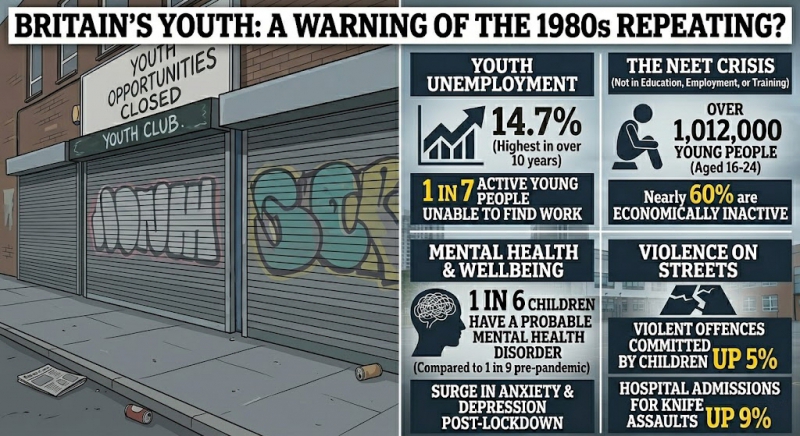
This time, the warnings are amplified by official statistics. Youth unemployment has surged to:- 14.7%, the highest rate in more than 10 years, with:- 1 in 7 young people actively seeking work but unable to find it. Even more concerning is that over:- 1,012,000 young people aged:- 16 to 24 are now classed as Not in Education, Employment, or Training. What makes this a stark warning of a return to the 1980s is the nature of the crisis: nearly:- 60% of these young people are economically inactive, meaning they are completely detached from the labour market. We are witnessing a shift from temporary youth unemployment to permanent detachment, threatening a lost generation. Combined with the spread of misinformation, a lack of accessible entry level jobs, and the growing costs of post school education which forces many into debt for decades, we have developed a highly combustible tinderbox.
This modern structural transition is uniquely dangerous because it is paired with a toxic mix of pandemic isolation and an overprotective education system. A stark post lockdown reality has emerged; experts warn that a catastrophic breakdown in resilience and social skills has left young people unable to navigate real world risks or the turmoil of their own minds. Educationalists argue that by bubble wrapping students and removing managed risks from playgrounds to avoid liability, schools have inadvertently disabled children's natural risk radar. Being risk blind is incredibly dangerous. Adolescents who never learn to calculate minor hazards cannot accurately assess the severe, life altering consequences of actions such as participating in street violence or mass rioting.
When you combine a total collapse of mental wellbeing with 0 economic prospects and a generation unable to gauge consequence, you create individuals with nothing to lose and 0 internal alarm system to stop them from resorting to violence. They cannot see the long term dangers of a criminal record, physical harm, or community destruction because their immediate emotional turmoil blinds them.
This internal turmoil is intrinsically linked to the social skills deficit driving violence on Britain's streets. Spending vital developmental years behind screens deprived a generation of the micro interactions needed to build emotional resilience. The result is a volatile landscape where minor disputes, fuelled by the distance of social media, escalate rapidly into physical aggression. While the number of teenage homicide victims has dropped to:- 34, a 10 year low attributed to aggressive policing and improved trauma care, other metrics are alarming. Violent offences committed by children have risen by 5%, and hospital admissions for knife assaults are up by 9%. These figures prove that the intent to harm and riot remains dangerously prevalent.
The toll on wellbeing is arguably even more devastating. Suicide remains the leading cause of death for the under 35s, claiming the lives of over:- 200 teenagers across the UK every year. The mental health statistics paint a picture of a generation in profound distress. 1 in 6 children now has a probable mental health disorder, compared to:- 1 in 9 before the Pandemic. This equates to:- 5 children in every average classroom needing clinical support. Self harm and depression surged by:- 35% among older teens in the immediate aftermath of lockdowns. Referrals to Child and Adolescent Mental Health Services have hit record levels, overwhelming a system struggling to cope. Geography also plays a cruel role. The North West of England has emerged as a tragic hotspot, with a child drowning rate 2 times the national average due to high deprivation and accessible waterways. In contrast, Scotland has successfully reduced accidental drownings by 10% through a dedicated national strategy.
In a bid to reverse these trends, the UK Government has launched initiatives, including a:- £10,000,000 investment in Behaviour Hubs to restore school discipline and a mandate to include rail safety in the national curriculum by September 2026. However, charities and mental health advocates argue that policy shifts alone are insufficient. They are calling for a cultural change to stop cotton wooling children, urging the reintroduction of managed independence and resilience building. The relentless focus on formal qualifications, alongside expecting candidates to pay for their own testing, is placing immense financial strain on vulnerable young people. Lower paid, essential roles that were traditionally ideal for those who are not academically minded are being decimated by over regulation. For example, employers are legally bound to demand specific credentials for everyday roles across sectors such as:- food preparation, security, lorry driving, and bricklaying. These positions frequently require low wage employees to personally fund and update their certifications every:- 2 or 3 years, for example the SIA licence for security staff. This creates massive barriers to entry. These staff often have huge responsibilities and like security staff, they are expected to out their lives on the line, yet often those employees cannot afford the training costs, whilst employers are forced to pay minimum wage to keep client costs down, ultimately creating a massive skills gap. Often these:- 'lesser skilled jobs,' require far more knowlage and skills than most so called:- 'skilled jobs,' yet they are increasinly undervalued employees. Furthermore, young recruits are often too inexperienced and unable to foresee workplace dangers, because they missed the essential childhood activities that would naturally make them risk aware. This often means a relience of onlder employees, again reducing the options for younger staff.
Within the education syatetm, we face increasing problems with modern constraints, liability issues, and structural vulnerabilities that make a return to unregulated play problematic. There are valid worries about disproportionately endangering underdeveloped or neurodivergent children. However, allowing these concerns to completely remove risk is destroying the wellbeing of our youth. 1 potential solution is following the template of Forest Schools, which have successfully integrated managed risk into the daily curriculum. Add to this mess, widespread budget cuts over the years mean teachers lack the operational capacity to safely monitor these activities without facing potential lawsuits or intense regulatory scrutiny from Ofsted.
If we are to succeed and grow as a nation, we must fundamentally rethink our educational system. This requires addressing the issues currently affecting so many by supporting small businesses, helping them employ new staff who can bring fresh ideas and an understanding of the changing business environment. Businesses must be able to latch on to new talent and train them without the risk of losing vast amounts of time and money. We also need to rethink education funding. We need to remove the financial barriers to education not only for teenagers but for all ages, allowing the nation to continually develop new skills. Embracing managed risk is also essential. Spoon feeding and wrapping a nation in cotton wool is not the way forward. We must allow children to learn to think outside the box and adapt. Finally, navigating technological shifts is critical. We need to manage the integration of AI to allow the workforce to evolve gradually. If we fail, we will soon face a situation far worse than the start of the Industrial Revolution or when computers 1st arrived in 1970s workplaces. If we do not act to rebuild youth wellbeing and help children become risk aware while adapting to an evolving economy, we risk a catastrophic return to the youth unemployment and violent social unrest of the:- 1970s and 1980s, but on a significantly larger scale.
If you or a young person you know is struggling with mental health or experiencing a crisis, the following UK services provide immediate, confidential support:-
This profound collapse of societal wellbeing and economic hope became the direct catalyst for the 1981 Toxteth riots. The devastation left scars on the region that lasted for decades. When a community's mental and economic wellbeing is entirely eroded, anger rapidly replaces aspiration. The riots were not born in a vacuum; they were the explosive, physical manifestation of 0 job opportunities, severe poverty, and an overwhelming feeling of abandonment by the establishment. A total lack of wellbeing pushes communities to breaking point, turning streets into battlegrounds. Shockingly, we are currently seeing a broken education system and political framework failing to adapt to a changing world, creating the exact conditions for mass civil unrest. The job market and the education system are once again seeing gaps turn into massive voids while the global economy undergoes another brutal structural transition.
This time, the warnings are amplified by official statistics. Youth unemployment has surged to:- 14.7%, the highest rate in more than 10 years, with:- 1 in 7 young people actively seeking work but unable to find it. Even more concerning is that over:- 1,012,000 young people aged:- 16 to 24 are now classed as Not in Education, Employment, or Training. What makes this a stark warning of a return to the 1980s is the nature of the crisis: nearly:- 60% of these young people are economically inactive, meaning they are completely detached from the labour market. We are witnessing a shift from temporary youth unemployment to permanent detachment, threatening a lost generation. Combined with the spread of misinformation, a lack of accessible entry level jobs, and the growing costs of post school education which forces many into debt for decades, we have developed a highly combustible tinderbox.
This modern structural transition is uniquely dangerous because it is paired with a toxic mix of pandemic isolation and an overprotective education system. A stark post lockdown reality has emerged; experts warn that a catastrophic breakdown in resilience and social skills has left young people unable to navigate real world risks or the turmoil of their own minds. Educationalists argue that by bubble wrapping students and removing managed risks from playgrounds to avoid liability, schools have inadvertently disabled children's natural risk radar. Being risk blind is incredibly dangerous. Adolescents who never learn to calculate minor hazards cannot accurately assess the severe, life altering consequences of actions such as participating in street violence or mass rioting.
When you combine a total collapse of mental wellbeing with 0 economic prospects and a generation unable to gauge consequence, you create individuals with nothing to lose and 0 internal alarm system to stop them from resorting to violence. They cannot see the long term dangers of a criminal record, physical harm, or community destruction because their immediate emotional turmoil blinds them.
This internal turmoil is intrinsically linked to the social skills deficit driving violence on Britain's streets. Spending vital developmental years behind screens deprived a generation of the micro interactions needed to build emotional resilience. The result is a volatile landscape where minor disputes, fuelled by the distance of social media, escalate rapidly into physical aggression. While the number of teenage homicide victims has dropped to:- 34, a 10 year low attributed to aggressive policing and improved trauma care, other metrics are alarming. Violent offences committed by children have risen by 5%, and hospital admissions for knife assaults are up by 9%. These figures prove that the intent to harm and riot remains dangerously prevalent.
The toll on wellbeing is arguably even more devastating. Suicide remains the leading cause of death for the under 35s, claiming the lives of over:- 200 teenagers across the UK every year. The mental health statistics paint a picture of a generation in profound distress. 1 in 6 children now has a probable mental health disorder, compared to:- 1 in 9 before the Pandemic. This equates to:- 5 children in every average classroom needing clinical support. Self harm and depression surged by:- 35% among older teens in the immediate aftermath of lockdowns. Referrals to Child and Adolescent Mental Health Services have hit record levels, overwhelming a system struggling to cope. Geography also plays a cruel role. The North West of England has emerged as a tragic hotspot, with a child drowning rate 2 times the national average due to high deprivation and accessible waterways. In contrast, Scotland has successfully reduced accidental drownings by 10% through a dedicated national strategy.
In a bid to reverse these trends, the UK Government has launched initiatives, including a:- £10,000,000 investment in Behaviour Hubs to restore school discipline and a mandate to include rail safety in the national curriculum by September 2026. However, charities and mental health advocates argue that policy shifts alone are insufficient. They are calling for a cultural change to stop cotton wooling children, urging the reintroduction of managed independence and resilience building. The relentless focus on formal qualifications, alongside expecting candidates to pay for their own testing, is placing immense financial strain on vulnerable young people. Lower paid, essential roles that were traditionally ideal for those who are not academically minded are being decimated by over regulation. For example, employers are legally bound to demand specific credentials for everyday roles across sectors such as:- food preparation, security, lorry driving, and bricklaying. These positions frequently require low wage employees to personally fund and update their certifications every:- 2 or 3 years, for example the SIA licence for security staff. This creates massive barriers to entry. These staff often have huge responsibilities and like security staff, they are expected to out their lives on the line, yet often those employees cannot afford the training costs, whilst employers are forced to pay minimum wage to keep client costs down, ultimately creating a massive skills gap. Often these:- 'lesser skilled jobs,' require far more knowlage and skills than most so called:- 'skilled jobs,' yet they are increasinly undervalued employees. Furthermore, young recruits are often too inexperienced and unable to foresee workplace dangers, because they missed the essential childhood activities that would naturally make them risk aware. This often means a relience of onlder employees, again reducing the options for younger staff.
Within the education syatetm, we face increasing problems with modern constraints, liability issues, and structural vulnerabilities that make a return to unregulated play problematic. There are valid worries about disproportionately endangering underdeveloped or neurodivergent children. However, allowing these concerns to completely remove risk is destroying the wellbeing of our youth. 1 potential solution is following the template of Forest Schools, which have successfully integrated managed risk into the daily curriculum. Add to this mess, widespread budget cuts over the years mean teachers lack the operational capacity to safely monitor these activities without facing potential lawsuits or intense regulatory scrutiny from Ofsted.
If we are to succeed and grow as a nation, we must fundamentally rethink our educational system. This requires addressing the issues currently affecting so many by supporting small businesses, helping them employ new staff who can bring fresh ideas and an understanding of the changing business environment. Businesses must be able to latch on to new talent and train them without the risk of losing vast amounts of time and money. We also need to rethink education funding. We need to remove the financial barriers to education not only for teenagers but for all ages, allowing the nation to continually develop new skills. Embracing managed risk is also essential. Spoon feeding and wrapping a nation in cotton wool is not the way forward. We must allow children to learn to think outside the box and adapt. Finally, navigating technological shifts is critical. We need to manage the integration of AI to allow the workforce to evolve gradually. If we fail, we will soon face a situation far worse than the start of the Industrial Revolution or when computers 1st arrived in 1970s workplaces. If we do not act to rebuild youth wellbeing and help children become risk aware while adapting to an evolving economy, we risk a catastrophic return to the youth unemployment and violent social unrest of the:- 1970s and 1980s, but on a significantly larger scale.
If you or a young person you know is struggling with mental health or experiencing a crisis, the following UK services provide immediate, confidential support:-
- PAPYRUS Prevention of Young Suicide:- Confidential help and advice for young people under the age of 35 who are experiencing thoughts of suicide, or anyone worried about a young person. Call:- HOPELINE247, on:- 08000684141, text:- 88247, or visit the website at:- Papyrus-UK.Org.
- Samaritans :- Available 24 hours a day, 365 days a year for anyone who needs someone to listen without judgment. Call:- 116123 for free, or visit the website at:- Samaritans.Org.
- Shout :- A free, confidential, 24/7 text messaging service for anyone in the UK who is struggling to cope. Text:- 'SHOUT' to:- 85258, or visit the website at:- GiveUsAShout.Org.
- Childline:- A free, private, and confidential service for children and young people up to the age of 19. Call:- 08001111, or visit the website at:- Childline.Org.UK
Food for thought... These are the statistics since the end of lockdowns looning at accidental deaths involving children in high risk areas (railways and water) and the number of children killed by violence (murder)
| Category | Trend | Key Statistic |
| Child Drowning Deaths | ▲ Increased | Deaths doubled (20 to 41) between:- 2019 and 2023 |
| Rail Trespass Deaths | ▲ Increased | Accidental rail deaths hit a:- 5 year high in 2025. |
| Teenage Homicides | ▼ Decreased | Fell to:- 34 in 2025 (lowest since:- 2013). |
| Youth Violent Offences | ▲ Increased | General violent offences by children up:- 5%. |
What are your thoughts on this topic? Please remember we are always interested to hear your views. Put your comments below, alternatively email us at:- News24@SouthportReporter.Com or send us a message on:- Mastodon, Facebook, or on:- X.