
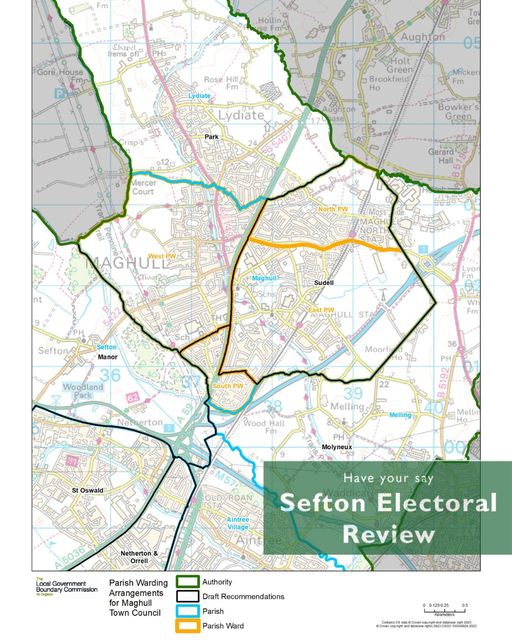
RESIDENTS living in Sefton are being reminded that a public consultation is taking place about the future of Sefton's Local Government Boundaries, known as an:- 'Electoral Review.'
This is the 2nd round of the consultations for this Electoral Review, and the closing date to submit to it is:- 18 March 2024.
This consultation is being conducted by The Local Government Boundary Commission (LGBCE) which is asking for the public to contribute to it.
But what is an Electoral Review? An Electoral Review examines and proposes new electoral arrangements for the whole local authority.
The areas being looked at are:-
This is the 2nd round of the consultations for this Electoral Review, and the closing date to submit to it is:- 18 March 2024.
This consultation is being conducted by The Local Government Boundary Commission (LGBCE) which is asking for the public to contribute to it.
But what is an Electoral Review? An Electoral Review examines and proposes new electoral arrangements for the whole local authority.
The areas being looked at are:-
- The total number of councillors to be elected to the Council; which is also referred to as the Council size.
- The names, numbers and boundaries of the Council's wards.
- The number of Councillors to be elected from each ward within the Council.
So how will this affect Sefton? We are told that the LGBCE is proposing that there should be 22 Wards with 3 Councillors in each Ward. This means most Ward Boundaries in Sefton will have to change.
Proposed changes include:-
Proposed changes include:-
- Changes to Park and Sudell wards based on local evidence received.
- A modified St Oswald ward that will have good electoral equality in 2029.
Once the Electoral Review has concluded, The Commission, set up by the LGBCE, will draw up new electoral arrangements to provide the best balance based on the statutory criteria.
The criteria include three main elements:-
The criteria include three main elements:-
- Delivering electoral equality for local electors. This means ensuring that each councillor represents roughly the same number of electors so that the value of your vote is broadly the same regardless of where you live in the local authority area.
- Interests and identities of local communities. This means establishing electoral arrangements which, as far as possible, avoid splitting local ties and where boundaries are easily identifiable.
- Effective and convenient local Government. This means ensuring that the wards can be represented effectively by their elected representative(s) and that the new electoral arrangements, including both the Council size decision and warding arrangements, allow the local authority to conduct its business effectively.
The Commission has a dedicated section on its website where people can see the details of the proposals and comment on the names of Wards and their boundaries:
Views can be submitted by email via:- Reviews@LGBCE.Org.UK, or you can send your thoughts on this Review by post to:-
Views can be submitted by email via:- Reviews@LGBCE.Org.UK, or you can send your thoughts on this Review by post to:-
Review Officer (Sefton)
LGBCE
PO Box 133
Blyth
NE24 9FE
Please also let us know your thoughts about this below...